


▽ PULiquid-applied & linings
Liquid polyurethane waterproofing
A liquid membrane that cures into a continuous, seamless rubbery layer, strong at details and penetrations.


What it is and how it works
Liquid polyurethane waterproofing is applied by roller, brush or spray over a suitable primer and cures by chemical reaction into a continuous, flexible, rubbery membrane fully bonded to the surface.
Its strength is detailing: it wraps drains, penetrations and corners without cutting or welding. Performance depends on the dry-film thickness and on surface moisture at the time of application; exposed roofs need a UV-resistant top coat where the system calls for one.
PU
- Family
- Liquid-applied & linings
- Used in
- Roof waterproofingWet-area waterproofingPool & water-feature waterproofingPlanter & landscape waterproofing
- Build-up
- 4 layers
Where it fits — and where it does not
A good fit for
- Roofs, terraces and balconies, exposed or under tiles
- Wet areas under tiles: bathrooms, kitchens and laundries
- Planters and podium details
- Areas crowded with penetrations and upstands
- Pools, where the specification allows
Not a fit, or needs a check
- Damp substrates or rising moisture during application: it bubbles
- Negative-side water pressure
- Contact with drinking water unless the product is approved for it
- Heavy vehicle traffic without a wearing system
Advantages and limitations
Every system has strengths and limits; the right choice starts from the site conditions.
Advantages
- Seamless and fully bonded, so water cannot travel beneath it
- Very good at details and penetrations
- Flexible; bridges hairline cracks
- Light, flame-free and easy to repair locally
Limitations
- Sensitive to substrate moisture and humidity while curing
- Thickness depends on the applicator and must be measured
- Some products need a UV top coat when exposed
- Surface preparation is critical to adhesion
System build-up
Top to bottom. Final thicknesses and materials follow the approved specification and the product TDS.
System build-up4 layers
Liquid polyurethane waterproofing
Select a layer to see what it does.
UV-resistant top coat
Added where the membrane stays exposed and the product requires it.
Exposed systems
Liquid PU membraneCore layer
Applied in two or more coats to the specified thickness, reinforced with fabric at corners and details.
Primer
Improves the bond and seals the pores; its type depends on the substrate and its moisture.
Concrete substrate
Sound, dry and clean, laid to falls, with cracks treated.
Preparation and application
Surface preparation
- Cured, sound, clean concrete; laitance removed by grinding
- Moisture checked before priming, e.g. the plastic-sheet test ASTM D4263 or a meter
- Cracks and joints treated; fillets at corners
- Falls and drains checked
- Surface temperature and dew point within the TDS limits
Application sequence
Primer
The primer the system specifies, at the stated rate.
Detail reinforcement
Reinforcing fabric or extra coats at corners, drains, upstands and cracks.
First coat
Applied evenly; the rate checked by area and quantity.
Second coat
Applied crosswise within the recoat window to reach the specified thickness.
Top coat or protection
A UV top coat when exposed, or a protection screed or tiles.
Testing
Thickness readings and a flood test where applicable.
General educational content; final values and requirements follow the manufacturer’s TDS and the approved project specification.
Checks and common mistakes
Quality checks
- Moisture reading recorded before the primer
- Wet-film checks during application; dry-film readings after cure
- Material used reconciled with the area
- Pull-off adhesion where specified (ASTM D7234 on concrete)
- Flood test before covering
Common mistakes
- Applying on damp concrete: pinholes and blisters
- One thick coat instead of the specified coats
- Missing the recoat window: a weak bond between coats
- No reinforcement at corners and drains
- Leaving it exposed without the top coat the system needs
Common questions
Can PU be applied over old tiles?
Sometimes — after an adhesion test and with the primer the system specifies; otherwise the layers are removed to sound concrete.
How is bubbling avoided when PU is applied?
By checking the substrate moisture, using a primer that seals the pores, applying when the concrete is not heating up, and keeping each coat to the thickness in the data sheet. See the problem page.
Does it need protection under tiles?
It depends on the system: some are tiled directly with a compatible adhesive, others need a protection screed.
Can polyurethane waterproofing stay in the sun?
Aromatic grades need a UV-resistant (aliphatic) top coat or a covering when left exposed, and the top coat is renewed as the data sheet advises; under tiles the membrane is out of the sun.
Manufacturers
Our documented relationship with each manufacturer; the specification sets the product.
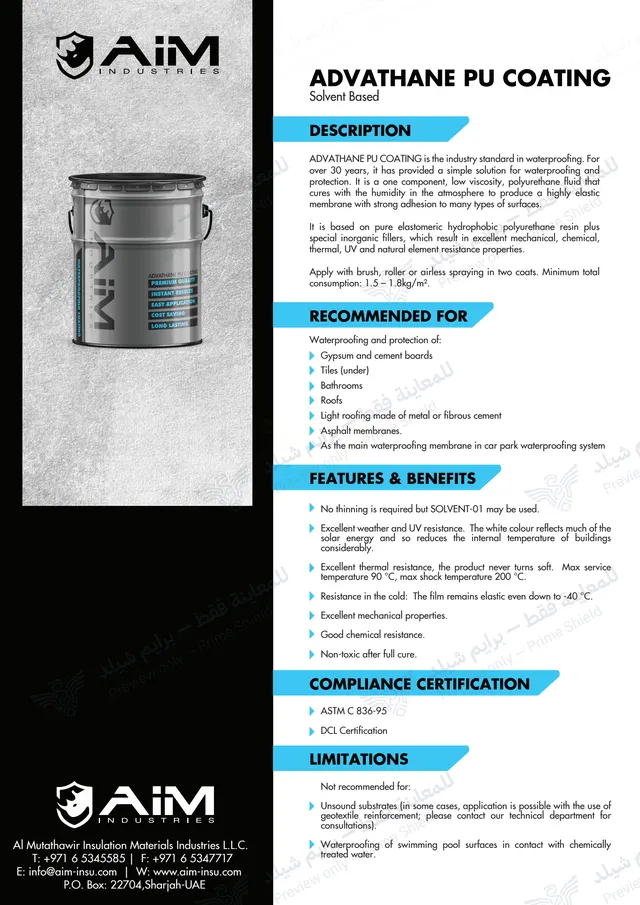
- AIM IndustriesApproved applicator · Sister company · Materials we have used
Next step
Considering this system for your project?
Send drawings or site photos; our engineers review the case and propose the right specification.